Email Us!

Have a question you'd like addressed? Send it to mikehaverkamp1960@gmail.com

Thursday, April 18, 2013

How Small Are We?

To give you an idea of the approximate size of University Heights compared to our neighbor to the east, north and west, namely the University of Iowa, here is a tidbit from the online version of the Cedar Rapids Gazette:


UI officials plan new Kinnick scoreboard, sound system

IOWA CITY — Kinnick Stadium will get a new scoreboard and sound system under a University of Iowa proposal that will go to the state Board of Regents next week. UI officials want to purchase a new video display and sound system for Kinnick from Daktronics, Inc., at a cost of up to $4.5 million, with the total cost of the purchase and installation of the system, equipment and infrastructure needs for installation not to exceed $8 million, according to meeting information released Thursday.

The UI is spending 4.5 million to buy a scoreboard. The FY 2014 University Heights municipalbudget approved at our March city council meeting totals $1.16 million. 


Wednesday, April 10, 2013

THE City Issue in a Nutshell

Many visitors to this site are probably coming after my most recent council meeting update. Since a good portion of you may be new to the community, you don't know a whole lot about One University Place. This is a proposed mixed use development on the site of the current St. Andrew Church.
This project was first proposed in 2008 and in 2009 community meetings began as well and zoning commission and city council hearings. This issue is what prompted me to run for City Council in 2009. It is a long and convoluted story.

Thursday, April 4, 2013

Sound Familiar?


Here's an interesting article from Planetizen posted  on 4/2/13


Author Brent Todarian, the former Chief Planner for the city of Vancouver, BC, tells of how over a 20 year period Vancouver has consistently enhanced their city using Smart Growth principles.

Here in U-Heights it has been hard to encourage some people to look at some higher density projects as well as mixed use projects that are at the heart of smart growth, and would help lead to a higher quality lifestyle for all of our residents. The two phrases I've heard most frequently over the last four years from those opposed to One University Place are "We're not a big city" and "We are a residential community." So when I read the article above I was struck by several points, including the idea that we in U-Heights are in essence "suburbia." Think about our town when you read this quote from the article:
"Unfortunately, even gentle forms of density can be especially controversial in the suburbs. Something as simple as secondary suites in single detached homes or backyard granny/”Fonzi” suites can lead to big battles. This has to change if city-regions stand a chance of addressing their serious issues." 

Substitute "landlocked small towns" for "city-regions" in the last sentence and it pretty well sums up the discussions regarding One University Place.

For quality development, Todarian proposes three guidelines:
1. Aligning your land-uses and how you get around!
2. Be unashamed to have a consistently high urban design standard!
3. Amenities make density enjoyable!

The first two points, we have some history with. U-Heights successfully fought an attempt to make Melrose Ave. a four lane through U-Heights. This is exactly what Vancouver did in the '60's when they prevented highways from cutting the city into pieces. We have had a high quality design standards as well,. Requiring a Planned Unit Development (PUD) to be agreed to prior to approval of any major redevelopment or infill project (Grandview and Birkdale) have assured consistent and quality results.
As to the third point, Todarian says it pretty succintly here:

"Amenities support public life, and the denser it gets, the more such amenities are needed. Design your density with parks, recreational and people places; childcare and schools; and cultural, civic and heritage offerings.
On top of publiclly owned amenities, density brings the population for market-driven amenities like the coffee shop, pub, grocery store and farmers market.
These amenities, public and privately owned, make density livable, lovable and successful, for all ages and for families if you design for them all."

This is where having some mixed use commercial at the intersection of our two arterial streets (Melrose and Sunset) could have have tremendous payback to our community.


Monday, April 1, 2013

Walking Locally

I'm continuing with my  pedestrian theme from last week's post. I found an interesting website over the weekend. It is called walkscore.com
You enter your address and get a walk-ability score of the area based on what's nearby. The maximum score is 100. The components of the score include: Restaurants, Entertainment, Arts & Community, Health, Shopping and Errands.

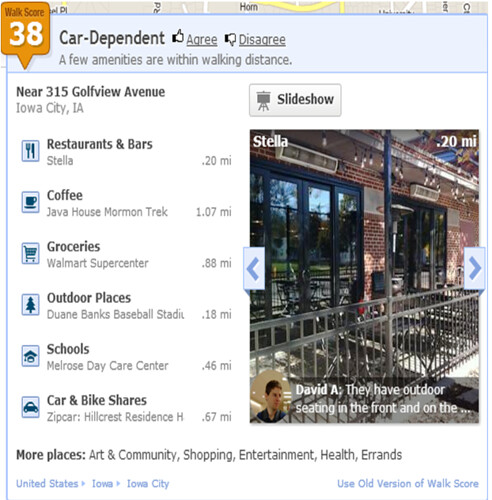
Here is the walkabilty results for my address:
I think this is pretty accurate. I can easily get "emergency" groceries (milk, bread, eggs, toilet paper) at Walgreens, not listed, on my bike, but otherwise we are somewhat car dependent. I do occasionally walk downtown, my youngest daughter and I like to do that, and then ride home on the Cambus. 

While reading the above, I was interested in was a claim from the 1926 real estate brochure for U-Heights that I have that says U-Heights is just as close to downtown Iowa City as Summit Street, or Manville Heights. (The exclusive neighborhoods of the era) That is certainly true, but how do their current walkability scores compare? 
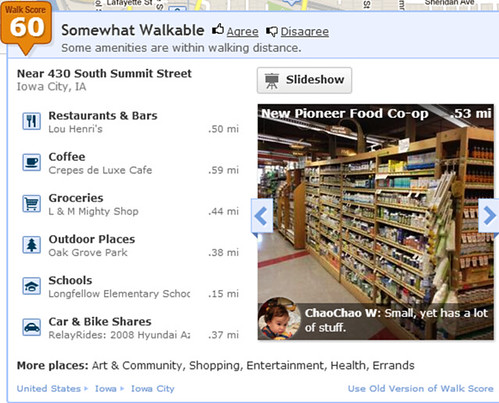
Here is Summit Street:
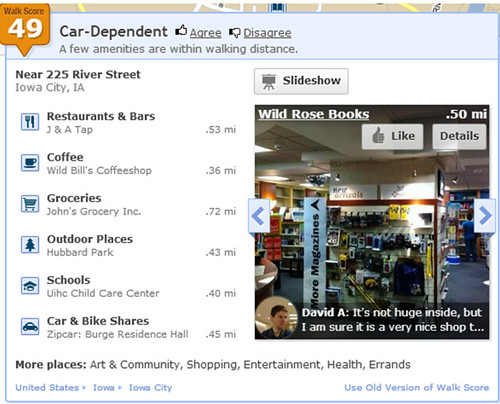
Here is Manville Heights:
No surprise that Summit scores highest, and that neither neighborhood is highly walkable, but both neighborhoods outscore U-Heights.

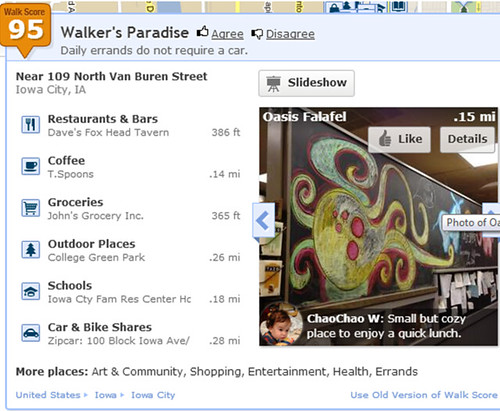
For real fun I put in our prior home where we lived until we moved to U-Heights:
Having lived in a walker's paradise prior to U-Heights, I can say that is really the one thing I've missed since moving. 
As shown, I speak from experience when I say that a few more amenities within walking distance would make for a great improvement in our community's quality of life!


Wednesday, March 27, 2013

Walking Through the News

Here are two stories that I recently read that keep popping back up in my head.

The first one was this from NPR station KPLU in Seattle:


Here is a bit from the story:

Two different types of walking

One clue emerges if you look at walking as having two different flavors. There’s recreational walking — you know, people who “go for a walk.” It’s healthy. It can be social.  
Other people walk in order to get somewhere or get things done. That’s transportation walking. 

This study, which had higher numbers of women who are white and middle-to-upper socioeconomic status, could have had more women who walk for recreation – and maybe these women are so motivated that it doesn’t really matter where they live. They might even drive to a park or a trail just to go walking.

An expert on teasing apart these types of walking, Brian Saelens of Seattle Children's Research Institute, says "transportation" walking depends a lot on where you live and work.
“It’s not that people are going to walk miles and miles to get to a destination,” Saelens said. “They have to be close enough so that the tradeoff between walking and driving makes sense for them, to say, ‘Oh, I might as well take a walk, because its just as fast or close to as fast.”’

In studies that look more carefully at how much people walk, by putting a tracking device on them, instead of relying on their recall, Saelens has found transportation walking can go under-reported. People forget that they walked to the bus, or to a store, because they weren't intentionally walking.
Recreational walking, which is what people usually talk about and remember, may depend less on the physical environment.

Right now U-Heights has a mix of transportation walkers (mostly UI Hospital employees) and recreational walkers. We have few destinations to draw more transportation walkers, perhaps the Sunset Wide Sidewalk, due to be completed by fall 2013, may encourage some. Having destinations in U-Heights besides Stella might encourage more walking.

Here's a story I read Monday night. This one comes from an interesting little site called PlaceMakers.


 Here's a quote from that story that really struck me:

“The trouble is that in the last half century, we have effectively engineered physical activity out of our daily lives. Health is determined by planning, architecture, transportation, housing, energy, and other disciplines at least as much as it is by medical care. … The modern America of obesity, inactivity, depression, and loss of community has not ‘happened’ to us; rather we legislated, subsidized, and planned it.” And that strong statement is according to three doctors, Andrew Dannenberg, Howard Frumkin, and Richard Jackson in their book, Making Healthy Places."

This is a different take on walking too, in digging into the Fuquay-Varina community mentioned in the story, it is a town of 18,000 so quite a bit bigger than U-Heights, but still a "small" town. The idea of  "suburban retrofit" is an excellent description of One University Place. For more information check: 

Wednesday, March 20, 2013

March Council Meeting Summary

  Here is my council summary I sent out last week, along with information about HF 184:

Last night city council held their regular March meeting, here are a few highlights:


1. Adopted FY2014 Budget- next year's budget will be tight due to the nearly 10% reduction of revenue as a result of the expiration of the Local Option Sales Tax in July 2013.

2. Gave Final Passage to Ordinance 182- This ordinance revises speed limits on non-arterial streets.

3. Gave First Approval to Ordinance 183- This ordinance defines the amount of back yards on East Olive Court may be used for parking.

Go here to view the February Council Meeting webstream.
Council will hold its April meeting on 4/9/13 at a place yet to be determined. 

Friday, March 15, 2013

HF 184 Good News... For Now

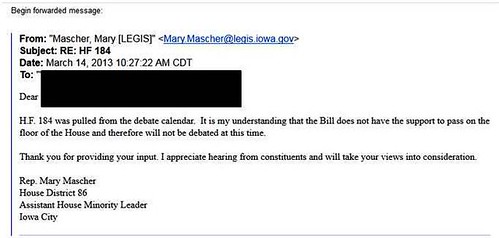
I got an email from a U-Heights citizen yesterday. He had emailed our Iowa House 86 Representative, Mary Mascher, about HF 184 yesterday. Below is the reply he received back from her:


We need to continue to contact House members, focusing on those outside of Johnson County, and urge them not to support HF 184. Since Republicans control the House, talking to them is recommended, but communicating with anyone is good. It's pretty easy to guess that House Leadership will continue to press members to support the bill, and bring it to the floor when they think it will pass.
Once again:
Here is the link to House members by county with their email addresses:

Iowa House

An interesting sidenote is to read which lobbyists have indicated they are in favor or opposed to HF 184:

 Lobbyist Declarations for HF 184
  
If HF 184 does not pass the full House AND a Senate Committee by April 5th , it will not have met the second funnel date and would in essence be dead for this legislative session.

Many thanks to our citizens who contacted legislators!